
The rapid democratization of radio frequency (RF) sensing is being driven largely by the global open-source software community. What was once proprietary technology locked away in university research labs is now accessible to any software engineer, maker, or IoT researcher. By sharing open C/C++ firmware, clean Python signal processing pipelines, standardized datasets, and pre-trained neural network weights, open-source projects are steadily breaking down these barriers. In this survey, we look at the leading open-source WiFi sensing and radar AI projects worth knowing in 2026.
The Open-Source Wireless Revolution
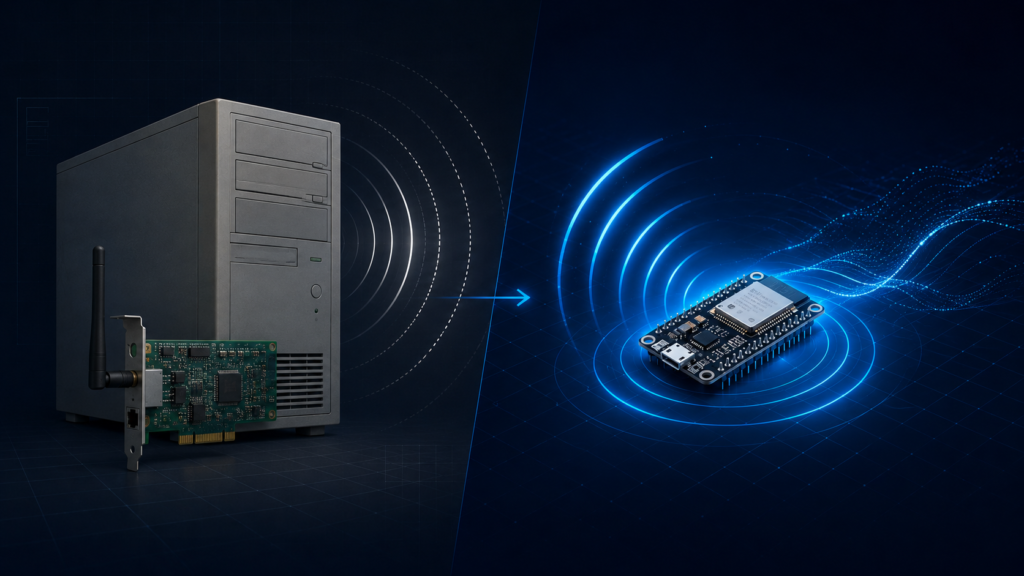
Historically, extracting Channel State Information required specialized hardware like Intel 5300 or Atheros AR9580 network interface cards, plugged into bulky Linux desktop towers running custom kernel patches. The real breakthrough came when community developers unlocked raw CSI preamble logging on affordable Espressif ESP32 microcontrollers. That single innovation dropped hardware entry costs from over $1,000 down to around $10, opening the door to global open-source collaboration.
Leading Open-Source WiFi Sensing Frameworks
1. RuView (GitHub: ruvnet/RuView)
The most complete end-to-end framework available today, combining C++ ESP32 firmware, Python DSP filtering pipelines, pre-trained CNN-LSTM models, and a live 3D WebSocket web dashboard.
2. ESP32-CSI-Tool
A lightweight firmware logger library for Espressif microcontrollers, offering basic C API routines to capture subcarrier packet arrays.
3. PicoScenes
A versatile research-grade middleware platform that supports commercial WiFi hardware (Intel, Qualcomm, HackRF SDR) for high-bandwidth academic measurement.
Standardized Datasets & Open Community Contributions
Open AI research depends on shared training data. Repositories like the Widar3.0 Dataset, MM-Fi, and community-driven RuView spectrogram databases provide thousands of annotated CSI wave recordings covering walking, gestures, fall events, and respiration. Contributing your own calibrated dataset recordings helps train universal foundation models that generalize well across different home layouts.
Electromagnetic Wave Propagation & CSI Physics
To really understand how wireless sensing works, it helps to look at the underlying physics of RF propagation. Traditional signals like RSSI only capture the average overall power of a received wireless packet. CSI goes further, extracting complex vectors that map individual Orthogonal Frequency-Division Multiplexing (OFDM) subcarrier channels. In a standard 20 MHz or 40 MHz WiFi spectrum, the signal is split into 56 to 114 separate subcarrier channels. For each one, the CSI packet header records the exact amplitude (signal attenuation) and phase (fractional cycle shift).
Human bodies are made up of more than 60% water, which makes them highly conductive dielectric objects in the path of 2.4 GHz and 5.8 GHz frequencies. As waves travel between transmitter and receiver, they bounce off walls, obstacles, and people, a phenomenon known as multipath propagation. The physical movement of a human body disturbs this multipath network, creating constructive and destructive interference patterns. For a hands-on look at how these physical shifts appear in real time, try our Interactive 3D WiFi Radar Demo.
Digital Signal Processing & CSI Denoising Pipelines
Raw CSI data streamed from low-cost IoT chips is inherently messy. Thermal drift, clock phase offsets, and ambient environmental interference all introduce significant high-frequency noise. The first step in our DSP pipeline is running the Base64 stream through a Hampel outlier filter.
We then apply Principal Component Analysis (PCA), which analyzes the covariance matrix across all 56 subcarriers and extracts the top three dominant variance components, discarding redundant channels in the process. To monitor rhythmic body signals such as respiration, the cleaned PCA streams are passed through a Butterworth bandpass filter tuned between 0.15 Hz and 0.35 Hz. For a more detailed walkthrough of how we isolate chest-wall displacements using these filters, see Breathing & Vital Signs Detection.
Deep Learning Architectures for Human Activity Recognition
Once the raw radio signals are clean, they’re formatted as a 2D spectrogram (time vs. subcarrier amplitude values), which allows us to apply computer vision techniques. A 2D convolutional neural network (CNN), such as a modified ResNet, scans the spectrogram to detect distinct micro-Doppler signatures.
To capture temporal actions, such as tracking whether a person is sitting down slowly or falling suddenly, we feed the CNN’s spatial features into a Long Short-Term Memory (LSTM) recurrent network. On localized edge servers like a Raspberry Pi 4, this hybrid CNN-LSTM pipeline runs in under 25ms with 96% classification accuracy. You can read a full architectural comparison of these AI models against traditional security cameras in our guide WiFi Radar vs Surveillance Cameras.