A practical breakdown of three of the most popular visual AI builders in 2026, and how to decide which one actually fits your project.
Two years ago, if you wanted to ship an AI agent, your options were Python, a stack of prompt templates, and a shaky while True loop wrapped around an LLM call. That’s changed fast. A class of visual, low-code platforms, led by n8n, Dify, and Langflow, now lets a developer, product manager, or founder drag nodes onto a canvas, connect them to a model provider, and have a working AI app running in an afternoon.
The catch is that these three tools aren’t actually solving the same problem, even though they get lumped together constantly. Picking the wrong one for your use case means fighting the tool instead of building with it. Here’s how they actually differ.
The Short Answer
If you just want the quick version: Dify wins for chat-first RAG apps and teams that want a productized AI application platform out of the box. n8n wins when AI is one piece of a larger operational workflow that also needs to touch your CRM, email, and a dozen other business tools. Langflow wins when you need Python-level flexibility, custom RAG pipelines, and LangChain or LangGraph-native components that you’ll eventually want to extend with real code.
Now here’s why.
Dify: The Productized AI App Platform
Dify positions itself as a full-stack AI application platform rather than just a workflow canvas. It bundles a knowledge base for document ingestion, prompt management, debugging tools, and a built-in app publishing system into one place, which is why it’s frequently recommended as the best starting point for teams that want to move fast without stitching multiple tools together.
Where Dify shines is chat-first applications: a support bot backed by your documentation, an internal Q&A tool over company policies, a RAG-powered assistant. Its knowledge base and hybrid-search retrieval are production-ready without much extra engineering, and its self-hosted free version has few meaningful limitations, so you’re not immediately pushed toward a paid tier just to get real functionality.
The trade-off is that Dify’s structure is somewhat opinionated. It’s built around the idea of an “app”, a chatbot, an agent, a workflow, published and served through its own interface. If your actual need is lighter, gluing together a handful of API calls, or heavier, deep custom multi-agent orchestration with fine control over state, Dify’s opinionated structure can feel like either overkill or a constraint.
n8n: Automation First, AI as a Module
n8n didn’t start as an AI tool. It’s a general-purpose workflow automation platform, the kind of tool that connects your email, your CRM, your database, and hundreds of other business apps, and it later added AI nodes on top of that existing automation engine. That lineage shows in exactly the way you’d expect: n8n is the strongest option when AI is one step inside a bigger operational pipeline, not the entire pipeline itself.
Consider a workflow where a new lead fills out a form, gets enriched with data from a CRM, has an LLM draft a personalized follow-up email, and that email gets queued for review before sending. n8n handles the trigger, the CRM lookup, the branching logic, and the email queue natively, with the LLM call as just one node among many. It’ll run reliably at scale too, n8n’s workflow engine is built to process large volumes of records per minute, which matters if you’re running this in production rather than as a one-off script.
Where n8n is a weaker fit is when the AI reasoning itself is the hard part, complex multi-agent coordination, custom retrieval strategies, fine-grained prompt engineering. It can do these things, but it wasn’t built with that as the primary use case, and you’ll feel that friction on more advanced agent workflows.
Langflow: The Visual IDE for LangChain and LangGraph
Langflow is best understood as a design canvas built on top of LangChain, rather than a deployment tool or a business automation platform. It’s excellent for experimenting with multi-agent systems, testing different RAG chunking strategies, comparing vector databases side by side, and visually tuning prompts before committing to a final pipeline.
The reason developers gravitate toward Langflow specifically is that it doesn’t box you in the way a more opinionated platform does. Its LangGraph integration and support for custom Python nodes mean that as your project’s complexity grows, you’re extending the same tool rather than outgrowing it and migrating somewhere else. For data teams building document intelligence systems, comparing retrieval approaches, or fine-tuning multi-agent flows, this flexibility is the entire point.
The trade-off is that Langflow feels less like a finished product and more like a power tool. It doesn’t come with Dify’s app-publishing polish or n8n’s enormous integration library. You’re trading some out-of-the-box convenience for room to grow into real engineering work later.
How Teams Actually Combine Them
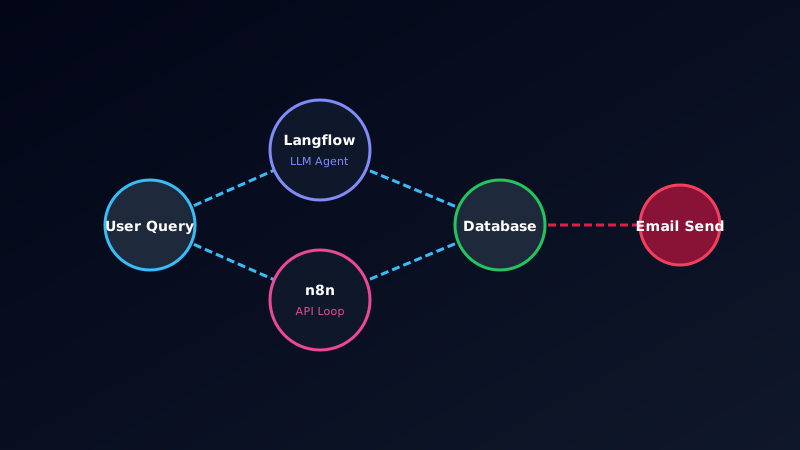
In practice, a lot of mature setups don’t pick just one. A common pattern looks like this: Langflow handles the RAG pipeline and agent design, where flexibility and experimentation matter most. That gets wrapped into a deployable endpoint. n8n then orchestrates the business logic around it, handling triggers, third-party integrations, and the operational plumbing that has nothing to do with the AI reasoning itself.
Similarly, teams building a chat-first product often reach for Dify as the core AI application layer, while still using n8n alongside it to handle the non-AI parts of the pipeline, scheduling, data routing, notifications, that Dify isn’t designed to own.
The honest takeaway here is that these tools aren’t strict competitors so much as they’re specialized for different layers of the same stack.
Where All Three Hit a Ceiling
It’s worth being upfront about the limits too. All three of these platforms start to strain once you need long-running multi-agent state, sub-second latency, or CI-grade automated testing around your AI logic. That’s typically the point where teams move some or all of the pipeline into a code-first framework like LangGraph or CrewAI, using the visual builder for prototyping and handing the production-critical parts to code.
That’s not a knock against any of the three, it’s simply the natural boundary of what a visual canvas is good for. Compressing LLM plumbing, prompt templates, retrieval, tool calls, conditional branching, into thirty minutes of drag-and-drop is the value proposition. Asking that same canvas to handle production-grade, low-latency, heavily-tested multi-agent orchestration is asking it to be something it wasn’t designed for.
Conclusion
There isn’t a single “best” tool among Langflow, Dify, and n8n, because they’re not really solving the same problem. Choose Dify if you want a chat-first AI application with a knowledge base and publishing built in, ready to go with minimal setup. Choose n8n if AI is genuinely just one step inside a much larger operational workflow that already needs to touch a dozen other business tools. Choose Langflow if you’re building or experimenting with custom RAG pipelines and multi-agent systems, and you know you’ll eventually want the flexibility to extend things with real Python code. And if your project outgrows all three at once, that’s usually the signal to move the AI-critical parts into a code-first framework, using whichever visual tool you started with purely for prototyping.
FAQs
Are Langflow, Dify, and n8n all open source?
Yes, all three are open source and can be self-hosted, though each also offers a hosted cloud version if you’d rather not manage your own infrastructure.
Which one is easiest for a non-developer to use?
Dify is generally considered the most beginner-friendly for building chat-first AI apps, thanks to its built-in knowledge base and app publishing system that require minimal technical setup.
Can I use more than one of these tools together?
Yes, and it’s a common pattern. Many teams use Langflow or Dify for the AI reasoning layer and n8n for the surrounding business automation, triggers, integrations, and data routing.
Which tool is best for a simple chatbot over my company documents?
Dify is typically the fastest path for this specific use case, since its knowledge base and retrieval features are production-ready with minimal additional engineering.
Do these tools replace the need to write code entirely?
Not for advanced use cases. All three hit a ceiling with long-running multi-agent state, low-latency requirements, or rigorous automated testing, at which point teams typically move critical logic into a code-first framework like LangGraph or CrewAI.