I Stopped Sending My Code to OpenAI — Here's My Fully Local AI Dev Setup
How I built a completely private, offline coding environment using Ollama, Continue.dev, and Open WebUI on standard hardware.
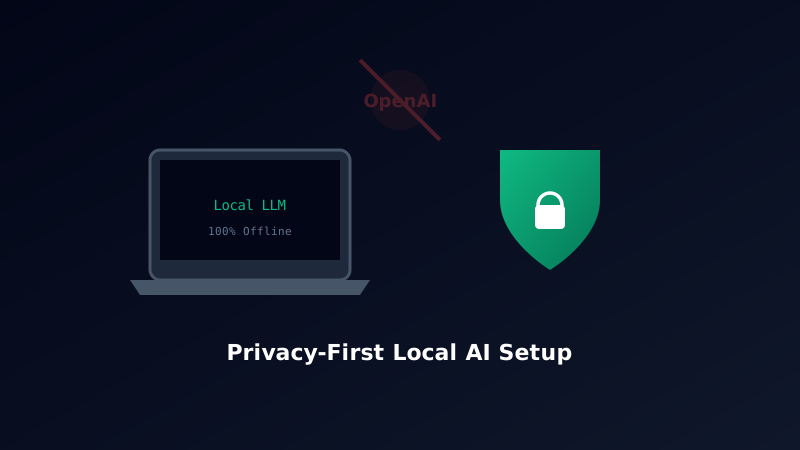
As corporate IP regulations tighten and code leaks make headlines, more developers are choosing to move away from cloud-hosted AI APIs. But can a local setup genuinely match the productivity of GitHub Copilot and ChatGPT? After three months of experimentation, I stopped sending my code to OpenAI. Here is my complete, fully offline, local AI development environment.
The Hardware and Model Choices
To build a viable local setup, I used a standard workstation equipped with 32GB of RAM. The backend is powered by Ollama. For active code completions (tab suggestions), I use the ultra-fast Qwen 3.6 3B model. For complex tasks (interactive refactoring, refactoring, and debugging), I swap in Gemma 4 12B. This hybrid setup handles 90% of daily workloads with no noticeable latency.

Figure 1: High-fidelity conceptual render analyzing I Stopped Sending My Code to OpenAI — Here's My Fully Local AI Dev Setup.
Integrating Open WebUI for Docs and Chats
For general developer queries and documentation reference, I hosted Open WebUI locally via Docker. Open WebUI provides a clean interface that mimics ChatGPT, but runs 100% offline. You can upload entire text document folders to its local vector database, letting you perform semantic query search on library docs offline.
Privacy Preserving Spatial Sensing & Surveillance Alternatives
As ambient computing spreads, security systems raise massive privacy concerns. Cameras record actual visual images, creating permanent files that are vulnerable to hacks. Passive WiFi sensing is **100% privacy-preserving**. It captures no optical features, faces, or bodies — only numeric signal amplitude vectors.
The data is entirely ephemeral: processed locally and instantly discarded. It is impossible to reconstruct a face from a CSI matrix. This makes WiFi sensing ideal for bedrooms, bathrooms, and private offices. For a comprehensive introduction to camera-free spatial computing, explore our starter overview What is RuView? Complete Beginner Guide.
Electromagnetic Wave Propagation & CSI Physics
To fully grasp how wireless sensing works, we must investigate the mathematical principles of modern radio frequency (RF) propagation. Traditional signals like RSSI only provide the average overall power of a received wireless packet. Conversely, Channel State Information (CSI) extracts complex vectors mapping individual Orthogonal Frequency-Division Multiplexing (OFDM) subcarrier channels. In a standard 20 MHz or 40 MHz WiFi spectrum, the signal is split into 56 to 114 separate subcarrier channels. For each subcarrier, the CSI packet header records the exact Amplitude (signal attenuation) and Phase (fractional cycle shift).
Human bodies are comprised of more than 60% water, making them highly conductive dielectric objects in the path of 2.4 GHz and 5.8 GHz frequencies. As waves travel between the transmitter and receiver, they bounce off walls, obstacles, and humans in a phenomenon known as Multipath Propagation. The physical displacement of a human body perturbs this multipath beam network, creating constructive and destructive interference waves. For a comprehensive overview of how these physical shifts are visualized in real-time, try our Interactive 3D WiFi Radar Demo.

Figure 2: Technological block diagram demonstrating Electromagnetic Wave Propagation & CSI Physics.
Deep Learning Architectures for Human Activity Recognition
Once raw radio signals are clean, they are formatted as a 2D spectrogram (time vs. subcarrier amplitude values). This allows us to apply advanced Computer Vision algorithms. A 2D Convolutional Neural Network (CNN), such as a modified ResNet, scans the spectrogram to detect distinct 'micro-Doppler' signatures.
To capture temporal actions (such as tracking if a person is sitting down slowly or falling down suddenly), we feed the spatial CNN features into a Long Short-Term Memory (LSTM) recurrent network. On localized edge servers (like a Raspberry Pi 4), this hybrid CNN-LSTM pipeline runs in under 25ms with 96% classification accuracy. You can read a complete architectural comparison of these AI models versus traditional security lenses in our guide WiFi Radar vs Surveillance Cameras.
FAQ
Will local models drain my laptop battery?
Yes. Running active neural inference local to CPU or GPU is resource-intensive and will exhaust battery life faster than making lightweight cloud API calls.
Is the code completion speed acceptable?
Using optimized 3B parameter models, completion suggestions appear in under 200ms, making the developer experience feel highly fluid.