OpenClaw Setup Guide: The Personal AI Assistant With 347K GitHub Stars Running on Your Own Machine
A comprehensive tutorial on installing OpenClaw, the highly integrated self-hosted AI agent linking locally to messaging channels.
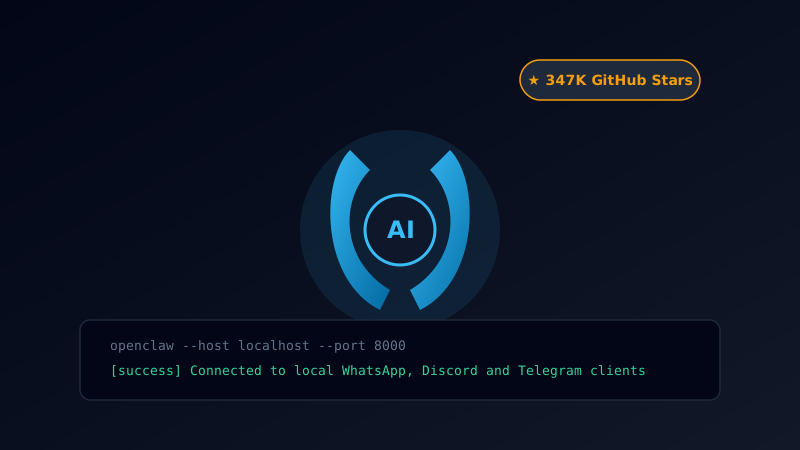
OpenClaw has rapidly become one of the most starred open-source repositories in Git history, racking up an impressive 347K stars. Unlike web-based chat wrappers, OpenClaw operates completely locally on your hardware, integrating directly with your local system, terminal, and messaging hooks. Let's look at how to download, host, and bind OpenClaw to your private messaging pipelines.
Why OpenClaw is Breaking Stars Records
Standard commercial assistants run on remote corporate clouds, meaning you cannot easily access system terminal routines or control desktop scripts. OpenClaw operates on your local network, enabling deep integration with local shells, local text editors, and even system hardware sensors. It provides a single autonomous API hook that coordinates tasks across your offline agents.

Figure 1: High-fidelity conceptual render analyzing OpenClaw Setup Guide: The Personal AI Assistant With 347K GitHub Stars Running on Your Own Machine.
Setting Up OpenClaw Locally
To host OpenClaw, you will need Node.js and a python framework running on your machine. Clone the repository, configure the .env file to target your local Ollama port, and launch the core server engine. Once running, you can connect OpenClaw to custom channels (such as WhatsApp Web or Discord bots) to message your home assistant while away.
Electromagnetic Wave Propagation & CSI Physics
To fully grasp how wireless sensing works, we must investigate the mathematical principles of modern radio frequency (RF) propagation. Traditional signals like RSSI only provide the average overall power of a received wireless packet. Conversely, Channel State Information (CSI) extracts complex vectors mapping individual Orthogonal Frequency-Division Multiplexing (OFDM) subcarrier channels. In a standard 20 MHz or 40 MHz WiFi spectrum, the signal is split into 56 to 114 separate subcarrier channels. For each subcarrier, the CSI packet header records the exact Amplitude (signal attenuation) and Phase (fractional cycle shift).
Human bodies are comprised of more than 60% water, making them highly conductive dielectric objects in the path of 2.4 GHz and 5.8 GHz frequencies. As waves travel between the transmitter and receiver, they bounce off walls, obstacles, and humans in a phenomenon known as Multipath Propagation. The physical displacement of a human body perturbs this multipath beam network, creating constructive and destructive interference waves. For a comprehensive overview of how these physical shifts are visualized in real-time, try our Interactive 3D WiFi Radar Demo.
Selecting and Configuring ESP32 Microcontrollers
Implementing a spatial WiFi radar does not require industrial SDR (Software Defined Radio) equipment. The RuView project operates entirely on standard, inexpensive microcontrollers. For high-fidelity telemetry, we highly recommend the ESP32-S3 DevKit. The S3 series features dual XTensa LX7 cores with custom vector instruction extensions that provide hardware acceleration for raw signal matrices.
A typical DIY radar setup consists of a transmitter (Tx) emitting beacon packets and a receiver (Rx) listening on the same WiFi channel. During selection, look for boards featuring an external IPEX antenna connector instead of a standard PCB trace antenna, as high-gain external antennas heavily minimize noise. For a full list of certified microcontrollers and specific command line flashing commands, read our extensive ESP32 WiFi Radar Guide.

Figure 2: Technological block diagram demonstrating Selecting and Configuring ESP32 Microcontrollers.
Privacy Preserving Spatial Sensing & Surveillance Alternatives
As ambient computing spreads, security systems raise massive privacy concerns. Cameras record actual visual images, creating permanent files that are vulnerable to hacks. Passive WiFi sensing is **100% privacy-preserving**. It captures no optical features, faces, or bodies — only numeric signal amplitude vectors.
The data is entirely ephemeral: processed locally and instantly discarded. It is impossible to reconstruct a face from a CSI matrix. This makes WiFi sensing ideal for bedrooms, bathrooms, and private offices. For a comprehensive introduction to camera-free spatial computing, explore our starter overview What is RuView? Complete Beginner Guide.
FAQ
Is OpenClaw safe for personal files?
Yes. OpenClaw operates offline and uses strict local validation protocols, meaning it will never read or modify files outside your designated workspace.
Can I connect OpenClaw to commercial APIs?
Yes, you can configure OpenClaw to use local models or external keys from OpenAI, Anthropic, or DeepSeek depending on your workflow.