RAG vs Fine-Tuning: I Tested Both and Here's When to Use Which
An honest comparison of Retrieval-Augmented Generation (RAG) and Fine-Tuning, detailing cost, performance, and use cases.
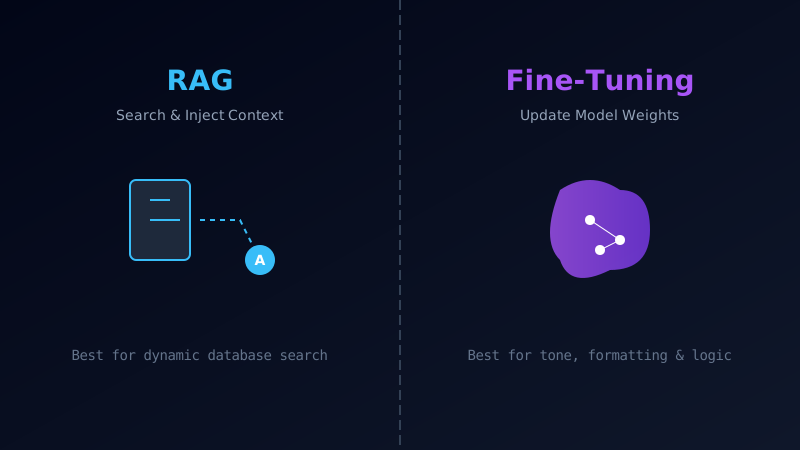
When building an enterprise AI application, you will eventually reach a critical architectural junction: should you build a RAG pipeline to retrieve documents dynamically, or should you fine-tune the model directly on your corporate data? I tested both strategies on the same database of complex product manuals. Here is when to use which.
RAG: The King of Dynamic Knowledge
RAG is the best choice if your data changes frequently (like stock prices, inventory counts, or updated document files). Because RAG queries a vector database in real-time, the AI always has access to the latest information without requiring retraining. RAG is also much cheaper to deploy and maintain.
Figure 1: High-fidelity conceptual render analyzing RAG vs Fine-Tuning: I Tested Both and Here's When to Use Which.
Fine-Tuning: The Master of Tone and Logic
Fine-tuning is the optimal path if you need the AI to follow strict output rules, format JSON structures perfectly, or adopt a highly specific writing voice. Fine-tuning doesn't teach the model new facts as well as RAG, but it teaches the model *how* to behave, allowing you to skip long instructions in your prompts, saving token cost.
Privacy Preserving Spatial Sensing & Surveillance Alternatives
As ambient computing spreads, security systems raise massive privacy concerns. Cameras record actual visual images, creating permanent files that are vulnerable to hacks. Passive WiFi sensing is **100% privacy-preserving**. It captures no optical features, faces, or bodies — only numeric signal amplitude vectors.
The data is entirely ephemeral: processed locally and instantly discarded. It is impossible to reconstruct a face from a CSI matrix. This makes WiFi sensing ideal for bedrooms, bathrooms, and private offices. For a comprehensive introduction to camera-free spatial computing, explore our starter overview What is RuView? Complete Beginner Guide.
Electromagnetic Wave Propagation & CSI Physics
To fully grasp how wireless sensing works, we must investigate the mathematical principles of modern radio frequency (RF) propagation. Traditional signals like RSSI only provide the average overall power of a received wireless packet. Conversely, Channel State Information (CSI) extracts complex vectors mapping individual Orthogonal Frequency-Division Multiplexing (OFDM) subcarrier channels. In a standard 20 MHz or 40 MHz WiFi spectrum, the signal is split into 56 to 114 separate subcarrier channels. For each subcarrier, the CSI packet header records the exact Amplitude (signal attenuation) and Phase (fractional cycle shift).
Human bodies are comprised of more than 60% water, making them highly conductive dielectric objects in the path of 2.4 GHz and 5.8 GHz frequencies. As waves travel between the transmitter and receiver, they bounce off walls, obstacles, and humans in a phenomenon known as Multipath Propagation. The physical displacement of a human body perturbs this multipath beam network, creating constructive and destructive interference waves. For a comprehensive overview of how these physical shifts are visualized in real-time, try our Interactive 3D WiFi Radar Demo.

Figure 2: Technological block diagram demonstrating Electromagnetic Wave Propagation & CSI Physics.
Deep Learning Architectures for Human Activity Recognition
Once raw radio signals are clean, they are formatted as a 2D spectrogram (time vs. subcarrier amplitude values). This allows us to apply advanced Computer Vision algorithms. A 2D Convolutional Neural Network (CNN), such as a modified ResNet, scans the spectrogram to detect distinct 'micro-Doppler' signatures.
To capture temporal actions (such as tracking if a person is sitting down slowly or falling down suddenly), we feed the spatial CNN features into a Long Short-Term Memory (LSTM) recurrent network. On localized edge servers (like a Raspberry Pi 4), this hybrid CNN-LSTM pipeline runs in under 25ms with 96% classification accuracy. You can read a complete architectural comparison of these AI models versus traditional security lenses in our guide WiFi Radar vs Surveillance Cameras.
FAQ
Can I combine RAG and Fine-Tuning?
Yes. Many advanced applications use a fine-tuned model (optimized to output clean API calls or structure responses) combined with a RAG pipeline (to supply accurate real-time data).
Which approach is cheaper to implement?
RAG is significantly cheaper to implement, requiring no GPU training time and leveraging low-cost vector databases.